
Japan
Labor Thanksgiving Day 2026: Japan’s November 23 Holiday Explained
Holiday date
23 November 2026
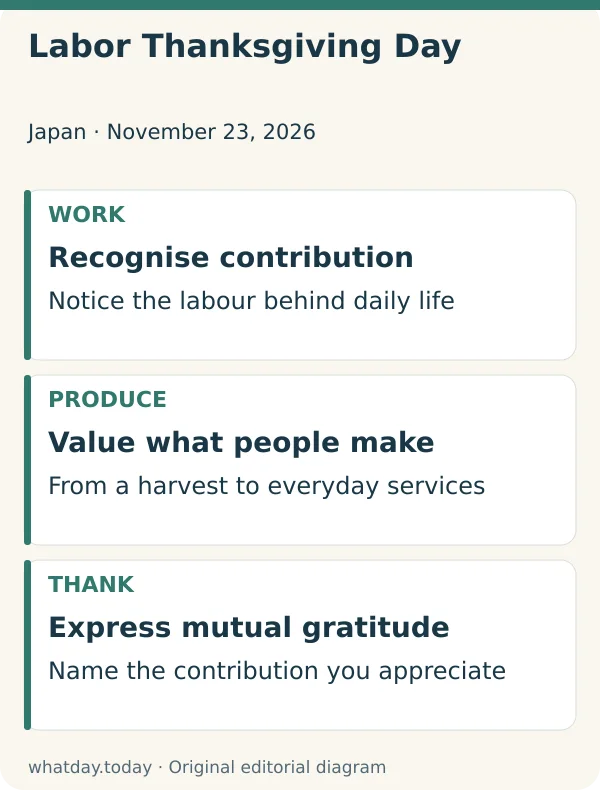
Labor Thanksgiving Day is Monday, November 23, 2026, in Japan. Known as Kinrō Kansha no Hi, it is a national holiday recognising work, production and mutual gratitude. It has a Japanese history linked to harvest observances and should not be confused with American Thanksgiving on November 26.
Calendar-day reference only; local programmes have their own times.
Holiday countdown
13 days left
until Labor Thanksgiving Day
Calendar days, not a countdown to a particular hour.
Swipe or scroll horizontally to compare all columns.
| Quick fact | Detail |
|---|---|
| Japanese name | 勤労感謝の日 — Kinrō Kansha no Hi |
| Date | Monday, November 23, 2026 |
| Country | Japan |
| Status | National public holiday |
| Annual rule | November 23; any substitute holiday must be checked separately |
What Kinrō Kansha no Hi means
The Cabinet Office’s national-holiday guide identifies November 23 as Labor Thanksgiving Day and explains the holiday’s purpose through respect for work, recognition of production and gratitude between people.
That emphasis makes it broader than thanks for one person’s job. Food, transport, education, care and public services depend on many kinds of labour, including work that is easily overlooked. The holiday offers a moment to notice those contributions rather than treating them as invisible parts of everyday life.
The English spelling also appears as Labour Thanksgiving Day. Both refer to the same Japanese holiday; the spelling difference does not indicate another date.
The harvest connection: Niinamesai
Web Japan, published by Japan’s Ministry of Foreign Affairs, connects the modern holiday with Niinamesai, an older harvest ritual involving an offering of newly harvested rice. It records the modern public holiday’s establishment in 1948.
Newly harvested rice connects the older ritual to the labour of growing food. The modern holiday, established in 1948, gives gratitude a wider civic meaning: appreciating work and the people whose efforts sustain daily life. Niinamesai and the public holiday share historical connections, but they are not interchangeable names for the same ceremony.
The older agricultural context and the modern recognition of work sit together in the day’s history. Readers can understand both without assuming that a national holiday requires everyone to take part in a religious practice.

Japan and the United States: different dates and traditions
Swipe or scroll horizontally to compare all columns.
| Question | Japan | United States |
|---|---|---|
| Name | Labor Thanksgiving Day | Thanksgiving |
| 2026 date | Monday, November 23 | Thursday, November 26 |
| Calendar rule | November 23 | Fourth Thursday in November |
| Focus in this comparison | Work, production and mutual gratitude | A separate American holiday with its own history and customs |
The nearby dates and shared English word are an easy source of confusion. A November itinerary should keep the two entries separate. An American Thanksgiving dinner in Japan may be organised by a restaurant or community, but that event does not define the Japanese national holiday.
For the American date and context, see our Thanksgiving article. Do not use an American holiday schedule to infer Japanese office hours or transport arrangements.
What the Monday date means for planning
For someone with a Saturday–Sunday weekend and Monday off, November 21–23 forms a three-day break. That is a calendar observation, not a promise about every worker’s rota or every business’s opening hours.
Before booking an appointment, check the institution itself. Before travelling, look at the transport operator’s timetable for the actual date and any reservation conditions. A national holiday label alone does not establish that a museum is closed, a restaurant is open or a particular train uses its usual weekday schedule.
The official 2026 calendar lists November 23 itself. Avoid carrying forward a substitute-holiday date from another year: the weekday changes, and an old travel article may describe a different calendar arrangement.
A simple way to explore the day’s theme
For a family or classroom, choose one ordinary object, such as a packed lunch. Map the work that made it possible: growing ingredients, transporting them, preparing food and keeping the spaces clean. Then identify one contribution you had not noticed before.
The point is to make gratitude specific. “Thank you for preparing our food” communicates more than a generic holiday slogan, particularly when it names real work without making assumptions about a person’s circumstances.
This is an optional learning activity proposed by this article. It is not a claim about a compulsory Japanese school custom or an official nationwide 2026 campaign.
Is there a special meal everyone eats?
Do not assume an American-style turkey dinner is part of the Japanese holiday. The sources used here explain the date through work, gratitude and harvest history; they do not prescribe one meal for every family.
Use the November calendar to compare nearby dates, and a local event or institution’s own notice for plans on the day.
Sources
Check the original sources for local arrangements and current guidance. External sources open in a new tab.
Plan around this date
See the day’s calendar · Browse this month · Labor Thanksgiving Day countdown
More to explore

New Year’s Day Beyond Midnight
New Year’s Day is January 1, but celebrations extend beyond the countdown. Selected Spanish, Scottish and Japanese customs carry the occasion from evening gatherings to sunrise and the first days of the year.
Mexico Revolution Day 2026: November 16 Holiday and November 20 Anniversary
Mexico Revolution Day’s 2026 rest day is November 16; the anniversary is November 20. Compare the dates and plan around local opening schedules.
Black Awareness Day 2026: November 20, Zumbi and Brazil’s National Holiday
Black Awareness Day is November 20, 2026. Learn why Brazil honours Zumbi, when it became a national holiday and how to read local event listings.
Image descriptions and credits are provided in the articles. AI illustrations are labelled.