
2026-11-20
World Children’s Day 2026: Date, Meaning and Activities
By whatday.today · Published
World Children’s Day is Friday, November 20, 2026. It is a global occasion to focus on children’s rights and listen to children’s views. UNICEF connects the date with the adoption of two important international documents in 1959 and 1989. UNICEF campaign
On this page
Why is World Children’s Day on November 20?What is the focus of World Children’s Day 2026?World Children’s Day activities for schoolsA 30-minute World Children’s Day classroom planWorld Children’s Day: children’s rights at homeIs World Children’s Day the same as every national Children’s Day?World Children’s Day questions answeredFor a school or family, World Children’s Day works best when children help shape what happens. The practical school activities below turn a discussion of children’s rights into something participants can explore, question and act on.
| Quick fact | Details |
|---|---|
| Date | Friday, November 20, 2026 |
| Main focus | Children’s rights and participation |
| Who can take part | Schools, families, young people and community groups |
| Planning note | National Children’s Days can have different dates |
Why is World Children’s Day on November 20?
On this date in 1959, the UN General Assembly adopted the Declaration of the Rights of the Child. In 1989, it adopted the Convention on the Rights of the Child. These milestones explain why World Children’s Day is associated with rights rather than simply gifts or entertainment. UNICEF background
The Convention covers matters such as education, protection, play and being heard. Its child-friendly version is a useful starting point for a World Children’s Day discussion: choose a few rights and explore what they mean in familiar situations. Children’s version of the Convention
Keep the distinction clear: rights belong to children; they are not prizes awarded for good behaviour. A classroom can discuss responsibilities and cooperation without suggesting that a child must earn the right to learn or be safe.
What is the focus of World Children’s Day 2026?
As checked on November 6, UNICEF’s global campaign page emphasizes children’s voices, their rights and their futures. We did not find a separately labelled official annual theme on that page. A campaign message should not automatically be presented as the worldwide “theme of 2026.”
Before using a slogan on a World Children’s Day poster, check the current campaign page and any relevant national UNICEF office. Local campaigns may have their own focus. For a classroom activity, it is also fine to give your project a clear original title without calling it an official theme.
World Children’s Day activities for schools
These are original editorial activity suggestions, not an official UNICEF lesson plan. The ages and timings are flexible guides. Choose an option that suits your group’s language, accessibility needs and available time.
| Activity | Suggested ages | Time | Materials | Intended result |
|---|---|---|---|---|
| Rights and everyday needs | 6–9 | 15 minutes | Picture or word cards | Connect a right with an everyday example |
| Listening circle | 8–12 | 15 minutes | Question card; optional paper | Practise hearing different views |
| A playground for everyone | 8–14 | 20 minutes | Paper and pencils | Identify one barrier and an improvement |
| A suggestion that gets an answer | 10–16 | 20 minutes | Notes or a shared board | Agree a proposal and a response date |
World Children’s Day: rights and everyday needs
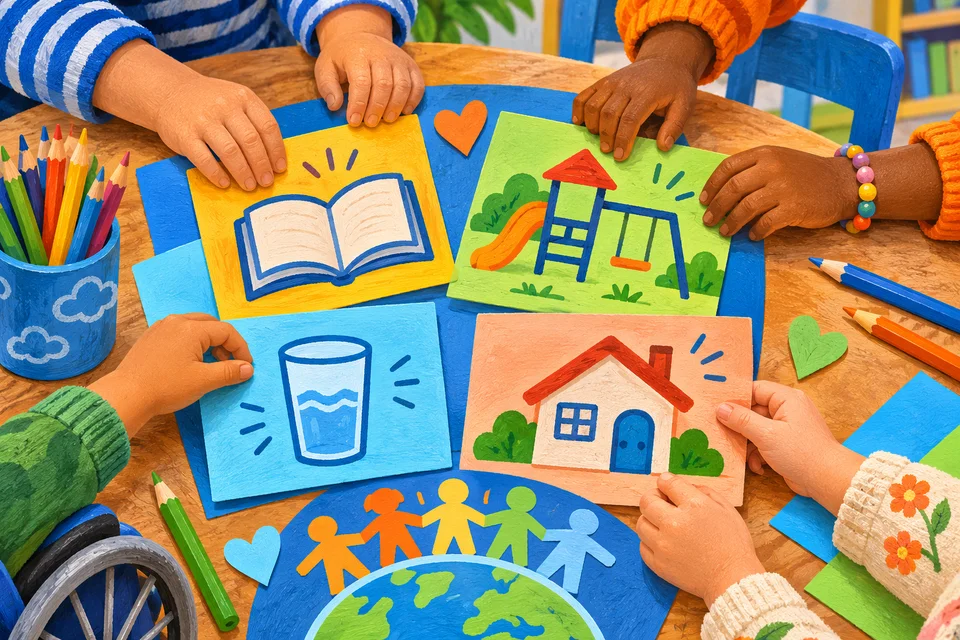
For younger pupils on World Children’s Day, prepare cards showing school, play, clean water, friendship, a favourite toy and a safe place to sleep. Ask small groups to explain which examples connect with rights and which describe a particular preference.
Use the child-friendly Convention to resolve questions rather than declaring one child’s favourite object “wrong.” The aim is to distinguish a right from a specific way of enjoying it: the right to play does not mean every child must own the same toy.
End by asking each group to draw one example. This gives your World Children’s Day display a meaning beyond a colourful title.
A listening circle for World Children’s Day
Choose a manageable question: “What would make break time more welcoming?” Allow participants to speak, draw or pass. Ask listeners to describe one idea they heard before adding their own.
For World Children’s Day, this exercise should show that listening is more than waiting for a turn. Record different views without pretending the group agrees on everything. Do not ask children to explain personal experiences of abuse, discrimination or family difficulties in front of others.
World Children’s Day: a playground for everyone
Ask groups to sketch a play space and consider someone who is new, uses a mobility aid or prefers a quieter activity. What might make joining in difficult? What change could help?
The World Children’s Day outcome is one specific proposal, such as clearer signs, a quieter corner or a different way to organize a game. Keep the focus on removing barriers, rather than asking classmates to speak for an entire group of people.
A suggestion that gets an answer
Give older pupils a real, limited decision to discuss. Examples include choosing a library display topic or improving information for new students. Explain in advance what they can influence and which constraints adults must handle.
A useful World Children’s Day project ends with a named person who will respond and a date for that response. If an idea cannot be adopted, explain why and discuss an alternative. Collecting suggestions without answering them teaches a different lesson from meaningful participation.
A 30-minute World Children’s Day classroom plan
Use this schedule when you want one complete session rather than several separate school activities.
| Time | What to do |
|---|---|
| Minutes 0–5 | Introduce the date and choose two or three rights from the child-friendly Convention |
| Minutes 5–15 | Run one activity from the table above |
| Minutes 15–25 | Let groups explain their examples or proposals; include a written response option |
| Minutes 25–30 | Agree one next step and explain when children will hear back |
Before the World Children’s Day session, prepare the materials and decide how children can participate without speaking publicly. During the discussion, use fictional or ordinary school examples so nobody has to reveal private information.
Afterwards, keep the promise to respond. A small improvement that children can see is a stronger result than a board full of suggestions that disappears the following week.
World Children’s Day: children’s rights at home
At home, begin with a choice that genuinely affects the child. Ask what would make a shared activity more comfortable, then listen before proposing the adult solution.
For World Children’s Day, a family could try one of these small projects:
- Choose a question together. Let the child select something about school, play or community life that they want to understand.
- Look at a local activity. Read its information together and consider whether a newcomer would know how to join.
- Make one suggestion. Help the child express an idea in their own words, then agree how to seek a response.
These child-led activities are opportunities for conversation, not tests with a correct emotional reaction. Children can be thoughtful without wanting to give a speech or appear in a photograph.
If your World Children’s Day activity produces pictures or written work, discuss what may be shared. Follow the school or group’s consent arrangements, and leave private family details out of public displays.
Is World Children’s Day the same as every national Children’s Day?
No. World Children’s Day falls on November 20, while national observances can use other dates. In India, Children’s Day is November 14, as described by the National Bal Bhavan. National Bal Bhavan
When sending an international invitation, write the full name and date. “Children’s Day next week” may mean different occasions to different recipients.
The November 20 calendar identifies the global observance. Browse international observances for other dates relevant to a school programme.
World Children’s Day questions answered
Must a school organize a large event?
No. One well-prepared conversation with a meaningful follow-up can be worthwhile. Choose a World Children’s Day activity that the group has time to finish and discuss.
Is wearing blue enough?
Blue is associated with the campaign, but a colour alone does not explain children’s rights. If you use it, connect the visual gesture with listening, learning or a concrete action.
Is November 20 automatically a school holiday?
No. Check the local school calendar. World Children’s Day is an observance, not a promise that schools everywhere will close.
Sources
Time until this observance
Days until this date · alarm · sleep calculator · Kyiv time · world clock