
Global, UNESCO
World Philosophy Day 2026: November 19 and Questions Worth Discussing
Holiday date
19 November 2026; third Thursday of November
World Philosophy Day is Thursday, November 19, 2026. UNESCO marks it on the third Thursday of November, so the numbered date changes each year. You do not need specialist knowledge to participate: a clear question, reasons for your answer and a willingness to listen are enough to begin.
The observance is November 19; the separate UNESCO Paris programme spans November 18–19.
Holiday countdown
9 days left
until World Philosophy Day
Calendar days, not a countdown to a particular hour.

Swipe or scroll horizontally to compare all columns.
| Quick fact | Detail |
|---|---|
| Date in 2026 | Thursday, November 19 |
| Calendar rule | Third Thursday of November |
| Organization | UNESCO |
| Focus | Philosophical inquiry, dialogue and thoughtful disagreement |
| Participation | Schools, universities, community groups and individual readers |
UNESCO explains the annual rule on its World Philosophy Day page. The Thursdays in November 2026 are the 5th, 12th, 19th and 26th.
Why the day matters
The day invites people to examine questions that can be hidden inside ordinary decisions. What makes a rule fair? How should we decide whether to trust a claim? What do we owe to someone whose circumstances differ from ours?
UNESCO connects philosophy with dialogue between cultures and the reasoned examination of different viewpoints. That makes the observance an opportunity to practise inquiry, rather than an exercise in memorizing a list of famous thinkers. UNESCO’s explanation.
Critical thinking involves more than finding a flaw in someone else’s answer. It also means checking your own assumptions and noticing when an example challenges them. A productive discussion can end with a better question instead of a unanimous conclusion.
UNESCO’s 2026 programme
UNESCO’s 2026 event page lists activities at its Paris headquarters and a November 19 lecture by philosopher Souleymane Bachir Diagne. The programme includes discussion of how people can think and act together. The event listing spans November 18–19, while the annual observance itself falls on November 19. UNESCO’s 2026 event information.
A local discussion does not have to reproduce that programme. If you want to attend the Paris event, use the organizer’s current registration information. If you are planning your own session, explain its actual format rather than suggesting that it is an official UNESCO event.
A real example: a public lecture in Athens
The University of Athens marked the day on November 20, 2025 with a lecture by Michael Sandel titled “In Search of the Common Good.” Its report describes the speaker and the audience in the university’s Great Hall. That is one example of philosophical discussion reaching a wider public, not a description of UNESCO’s Paris programme for 2026. University of Athens event report.
A lecture and a small group exercise offer different kinds of participation. The questions below provide a starting point for readers who want to try a discussion themselves.
Three questions for a group
The following philosophy questions are original discussion prompts you can adapt. They work best when participants have time to give reasons and consider examples.
Is treating everyone the same always fair?
Imagine a group preparing for an activity. Everyone receives the same written instructions, but one person cannot read the print size. Has equal treatment produced a fair opportunity to participate?
Ask participants to distinguish sameness from fairness. Then change one detail in the example and see whether their answer changes. The aim is to understand the principle behind an answer, not to guess what the facilitator wants to hear.
What makes a source worth trusting?
Suppose two websites give different dates for the same event. What would you check: who published the page, whether the year is shown, whether it links to an organizer or whether the information agrees with a calendar rule?
This prompt connects critical thinking with a familiar task. A confident tone is not the same as good evidence. Ask learners to explain which checks would resolve the disagreement and which would merely make a page look impressive.
Can a good decision have a bad outcome?
Imagine that someone chooses an activity after carefully checking the available information, but an unexpected event spoils the plan. Does the result alone prove that the original decision was poor?
Separate what the person could reasonably know at the time from what becomes clear afterward. Ask whether the group judges the decision differently when one detail changes. Keep the example ordinary so participants can focus on the reasoning.
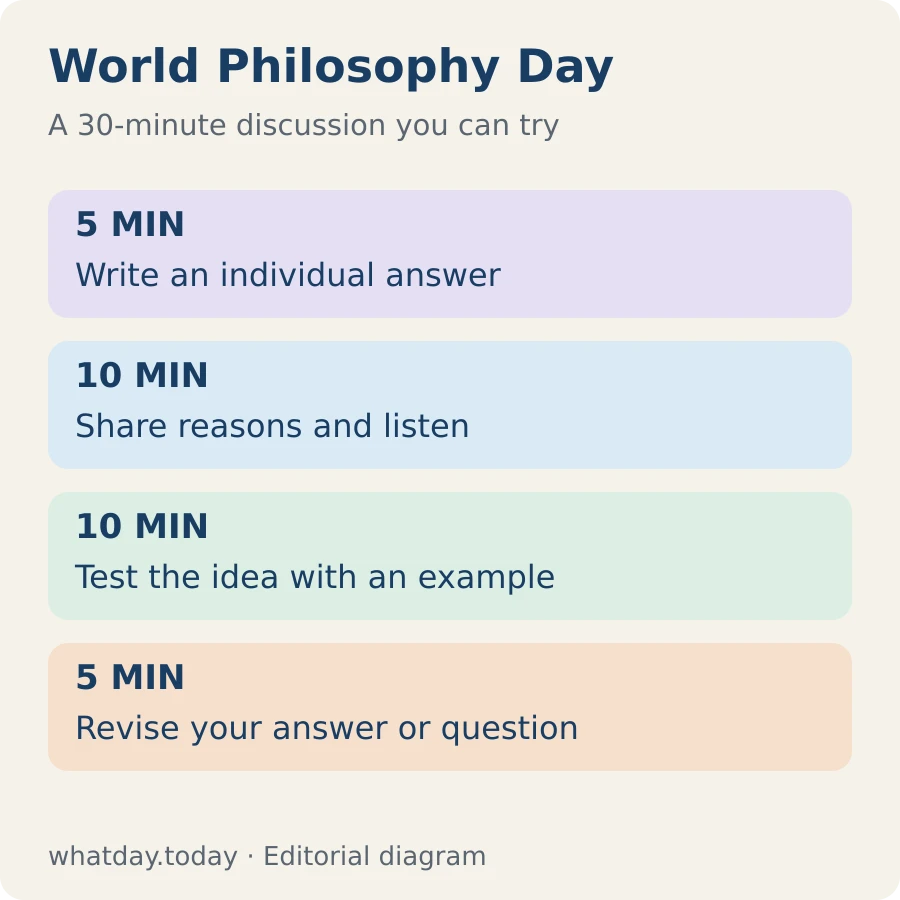
A 30-minute discussion plan
Swipe or scroll horizontally to compare all columns.
| Time | Activity | Purpose |
|---|---|---|
| First 5 minutes | Introduce one question and write individual answers | Give everyone a starting point |
| Next 10 minutes | Share reasons in pairs or small groups | Practise listening before responding |
| Next 10 minutes | Test an answer with a new example | Examine assumptions |
| Final 5 minutes | Write a revised answer or a remaining question | Notice what changed |
One question explored carefully is usually more manageable than several unrelated debates. Choose a facilitator who can keep the group on topic without deciding every answer for it.
Allow participants to pass or respond in writing. A lively speaker should not receive all the time simply because they answer first. Philosophy questions become more interesting when the group can hear different approaches.
Ground rules for the discussion
Ask people to challenge an idea rather than attack the person expressing it. Before disagreeing, invite them to summarize the point they are responding to. This can reveal whether the disagreement concerns the conclusion, the evidence or the meaning of a word.
Distinguish a factual claim from a hypothetical example. Facts may need checking; an imagined situation needs a clear description. Neither becomes more convincing just because someone repeats it loudly.
End the discussion by asking which philosophy questions participants would investigate next. Critical thinking continues beyond the meeting when a person checks a source, revises an assumption or asks a more precise question.
Why do some World Philosophy Day pages show November 20?
World Philosophy Day follows the third Thursday, not a fixed numbered date. November 20 was the third Thursday in 2025; in 2026 it is November 19. Check the year and the rule before copying a date into an invitation.
Do I need to have studied philosophy?
No. A discussion can begin with an everyday example and a question you genuinely want to explore. Specialist reading can add depth, but it should help people reason together rather than make participation feel like a test.
See the November 19 calendar for the date alongside other observances.
Sources
Check the original sources for local arrangements and current guidance. External sources open in a new tab.
Plan around this date
See the day’s calendar · Browse this month · World Philosophy Day countdown
More to explore

New Year’s Day Beyond Midnight
New Year’s Day is January 1, but celebrations extend beyond the countdown. Selected Spanish, Scottish and Japanese customs carry the occasion from evening gatherings to sunrise and the first days of the year.
Mexico Revolution Day 2026: November 16 Holiday and November 20 Anniversary
Mexico Revolution Day’s 2026 rest day is November 16; the anniversary is November 20. Compare the dates and plan around local opening schedules.

Diwali 2026
When is Diwali in 2026? Check the November 8 date, understand Deepavali and local holiday differences, and learn how to join a celebration respectfully.
Image descriptions and credits are provided in the articles. AI illustrations are labelled.