
Global, UN
World Toilet Day 2026: Date, Theme and What Safe Sanitation Means
Holiday date
19 November 2026
World Toilet Day is Thursday, November 19, 2026. UN-Water’s announced theme is “Sanitation and gender equality.” The day focuses on access to safe toilets and sanitation, including the privacy, safety, water and hygiene facilities people need in everyday life.
Calendar counter only; no assumption about a local campaign event time.
Holiday countdown
9 days left
until World Toilet Day
Calendar days, not a countdown to a particular hour.
Swipe or scroll horizontally to compare all columns.
| Quick fact | Detail |
|---|---|
| Annual date | November 19 |
| 2026 theme | Sanitation and gender equality |
| Campaign coordinator | UN-Water |
| Origins | World Toilet Organization, 2001 |
| UN observance since | 2013 |
The UN-Water campaign page explains the history and theme.
Why have a day about toilets?
A toilet is the visible starting point of a larger sanitation system. If waste is not contained and safely treated, the presence of a toilet alone does not settle what happens to it afterward. The day draws attention to that often-hidden connection between an everyday facility and public wellbeing.
WHO reports that 3.4 billion people lacked safely managed sanitation in 2024. This is not the same as saying that all 3.4 billion had no toilet: the measure also considers how waste is managed. The data year is 2024, even though the WHO fact sheet was updated in November 2026. WHO: sanitation.
That distinction prevents a misleading comparison. Counting toilets and measuring safely managed sanitation answer related but different questions.
What does “safely managed sanitation” mean?
For household monitoring, the WHO/UNICEF Joint Monitoring Programme describes improved facilities not shared with other households, with waste safely disposed of on site or removed and treated elsewhere. JMP sanitation definitions.
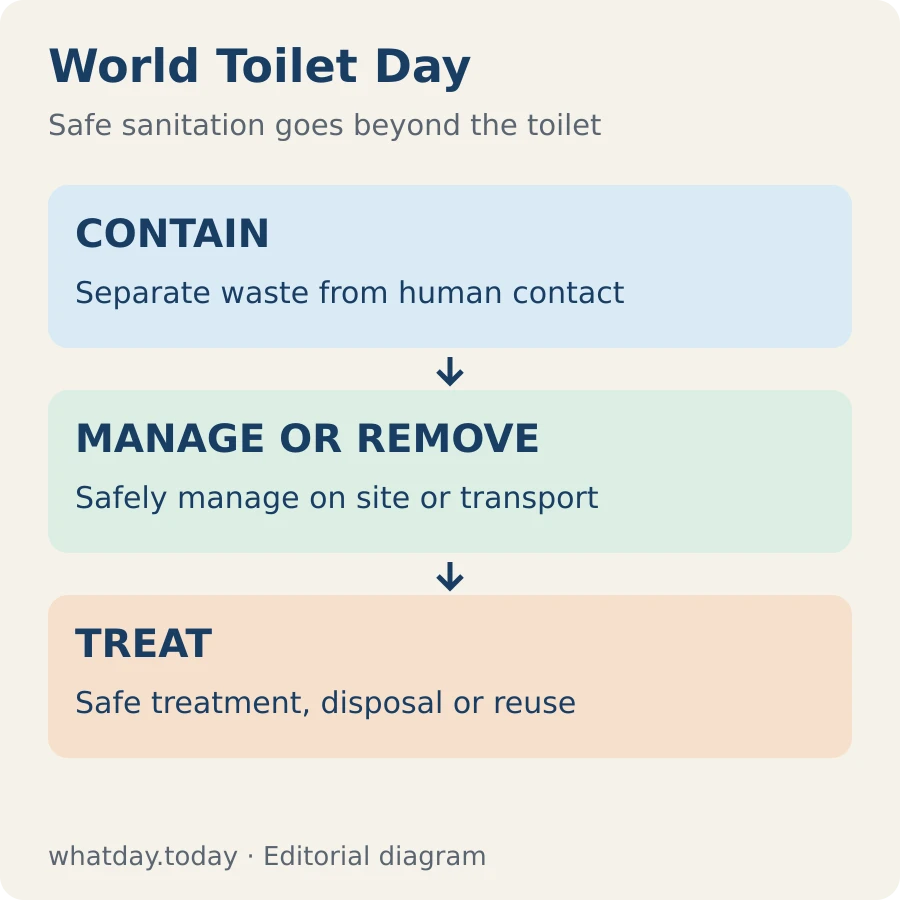
A simplified chain helps explain the parts:
Swipe or scroll horizontally to compare all columns.
| Stage | What needs to happen |
|---|---|
| Use and containment | The facility separates waste from human contact and contains it appropriately |
| On-site management or removal | Waste is safely managed on site, or emptied and transported for treatment |
| Treatment and final disposal or reuse | The remaining material is managed safely rather than discharged untreated |
Not every system uses a sewer, and not every system has the same sequence of equipment. The table is an explanation of the principle, not instructions for designing or inspecting a sanitation system. JMP: monitoring on-site sanitation.
The household indicator also should not be used to declare that a public toilet is automatically unsafe simply because different people use it. The setting and the question being measured matter.
The 2026 theme: sanitation and gender equality
UN-Water’s theme connects sanitation with the needs of women and girls, including secure facilities, privacy, water, soap and menstrual hygiene. A facility may technically exist but still be difficult to use with dignity. UN-Water’s 2026 campaign.
For example, a school discussion can distinguish the number of toilets from whether doors close, water is available and users have a private way to report problems. These are practical questions to raise with the responsible staff, not a substitute for a professional assessment.
How the campaign is made visible
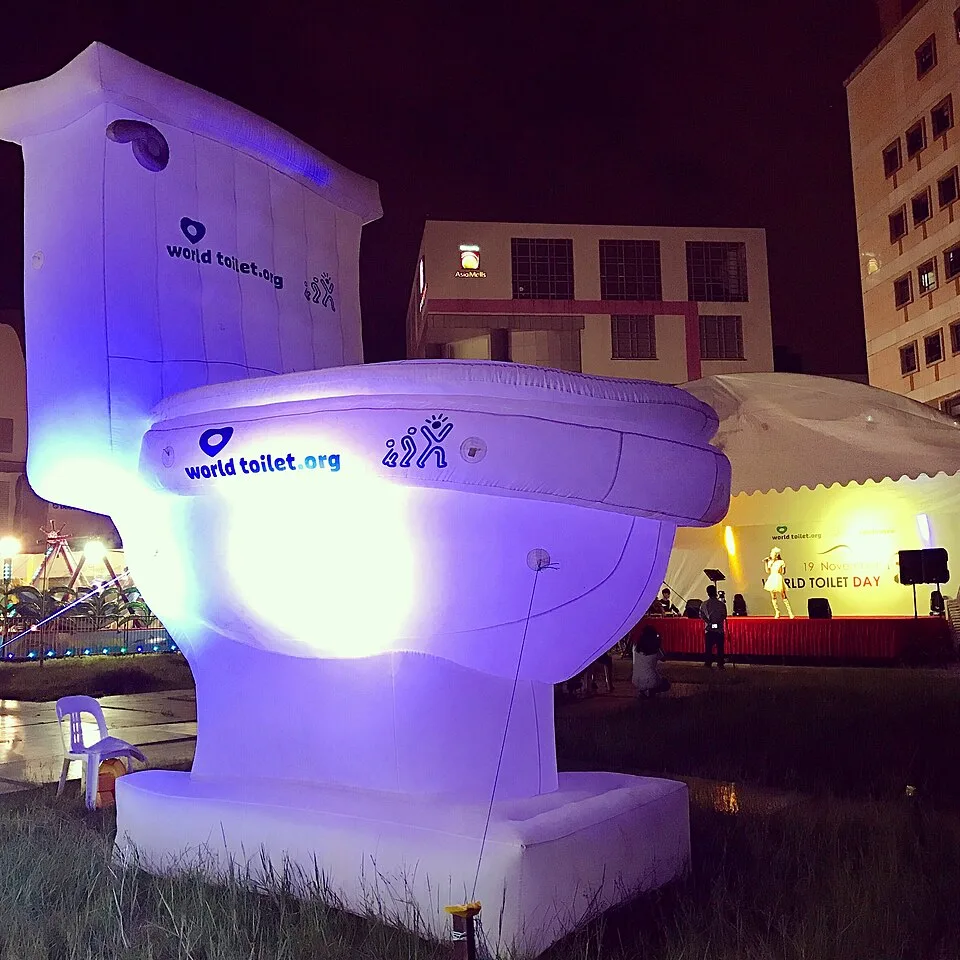
Public installations can make an overlooked subject hard to miss. A 2016 World Toilet Day roadshow in Singapore used a giant inflatable toilet beside its stage. A separate 2015 installation placed one outside the United Nations buildings in New York. Both are documented in the Singapore image record and New York image record.
Those photographs illustrate awareness activities from earlier years. The installations are not examples of treatment technology or announcements of the 2026 programme. Their value is in showing how a campaign brings an everyday object into a public conversation.
A practical activity for a school or workplace
Choose one setting and ask what information its users need:
- Where are the accessible facilities, and is the route clear?
- Who receives a report about a broken lock or missing supplies?
- Can someone report a privacy concern without discussing it publicly?
- Is responsibility for following up clearly assigned?
Record a specific issue and pass it to the responsible team. Do not enter occupied facilities, photograph users or attempt a technical inspection. A useful outcome is a documented response or repair, not simply a list of concerns.
Where can I find the official campaign?
Use UN-Water’s page above for the annual theme and campaign links. For a local event, check the organizer’s own date and venue. Keep the year visible when sharing a poster so an older campaign does not become the apparent theme for 2026.
See November 19 for the wider calendar.
Sources
Check the original sources for local arrangements and current guidance. External sources open in a new tab.
Plan around this date
See the day’s calendar · Browse this month · World Toilet Day countdown
More to explore

New Year’s Day Beyond Midnight
New Year’s Day is January 1, but celebrations extend beyond the countdown. Selected Spanish, Scottish and Japanese customs carry the occasion from evening gatherings to sunrise and the first days of the year.
Mexico Revolution Day 2026: November 16 Holiday and November 20 Anniversary
Mexico Revolution Day’s 2026 rest day is November 16; the anniversary is November 20. Compare the dates and plan around local opening schedules.

Diwali 2026
When is Diwali in 2026? Check the November 8 date, understand Deepavali and local holiday differences, and learn how to join a celebration respectfully.
Image descriptions and credits are provided in the articles. AI illustrations are labelled.