
Global, UNESCO
International Day for Tolerance 2026: Meaning, Events and Classroom Activities
Holiday date
16 November 2026
The International Day for Tolerance is Monday, November 16, 2026. It concerns respect for people’s dignity, rights and differences. Schools and community groups can mark it through discussion and practical changes; UNESCO is also holding its Madanjeet Singh Prize ceremony in Paris on the date.
Calendar date only; classroom and local schedules may differ.
Holiday countdown
6 days left
until International Day for Tolerance
Calendar days, not a countdown to a particular hour.
Swipe or scroll horizontally to compare all columns.
| Quick fact | Detail |
|---|---|
| Annual date | November 16 |
| Background | UNESCO’s 1995 Declaration of Principles on Tolerance |
| UN recognition | General Assembly resolution adopted in 1996 |
| 2026 UNESCO event | Prize ceremony in Paris, 18:00–19:30 CET |
UNESCO’s overview explains the day’s origins. The 2026 ceremony announcement provides the event arrangements.
What does tolerance mean?
UNESCO’s declaration connects tolerance with respect for human diversity and fundamental rights. It does not mean indifference, agreement with every opinion or acceptance of harm.
Consider two situations. Members of a club disagree about which film to show: they can explain their preferences and choose a fair decision process. A member is excluded because of their background: treating that exclusion as just another harmless preference would miss the issue of equal participation. These are illustrative scenarios, not cases reported by UNESCO.
The difference helps turn an abstract value into a useful question: are we disagreeing about an idea, or denying someone fair treatment? A discussion can protect a person’s dignity while examining an opinion critically.
Why November 16?
UNESCO’s member states adopted the Declaration of Principles on Tolerance on November 16, 1995. In 1996, UN General Assembly resolution 51/95 invited countries to observe the date annually, including through educational activities. UN resolution 51/95.
The date is fixed, not tied to a particular weekday. A school activity can take place on a nearby day without changing the annual observance.
The UNESCO prize ceremony in 2026
UNESCO’s announced programme places the Madanjeet Singh Prize ceremony at its Paris headquarters on November 16, from 18:00 to 19:30 CET. It is open to the public with limited seats and registration through the event page. An artistic performance is also announced. Check that page for changes before travelling. Programme and registration.
The prize recognises contributions to tolerance and non-violence. It bears the name of Madanjeet Singh, an artist, writer, diplomat and UNESCO Goodwill Ambassador. Its history gives the observance a concrete example of sustained work being recognised, rather than only a one-day slogan. About the prize.
Three classroom activities
These are original suggestions to adapt to the learners, not an official UNESCO lesson plan.
Swipe or scroll horizontally to compare all columns.
| Activity | Suggested age | Time | Purpose |
|---|---|---|---|
| Listen and reflect | 9 and above | 15 minutes | Understand a view before answering |
| Redesign an invitation | 11 and above | 20 minutes | Notice barriers to participation |
| Disagreement or exclusion? | 13 and above | 20 minutes | Distinguish ideas from unfair treatment |
Listen and reflect
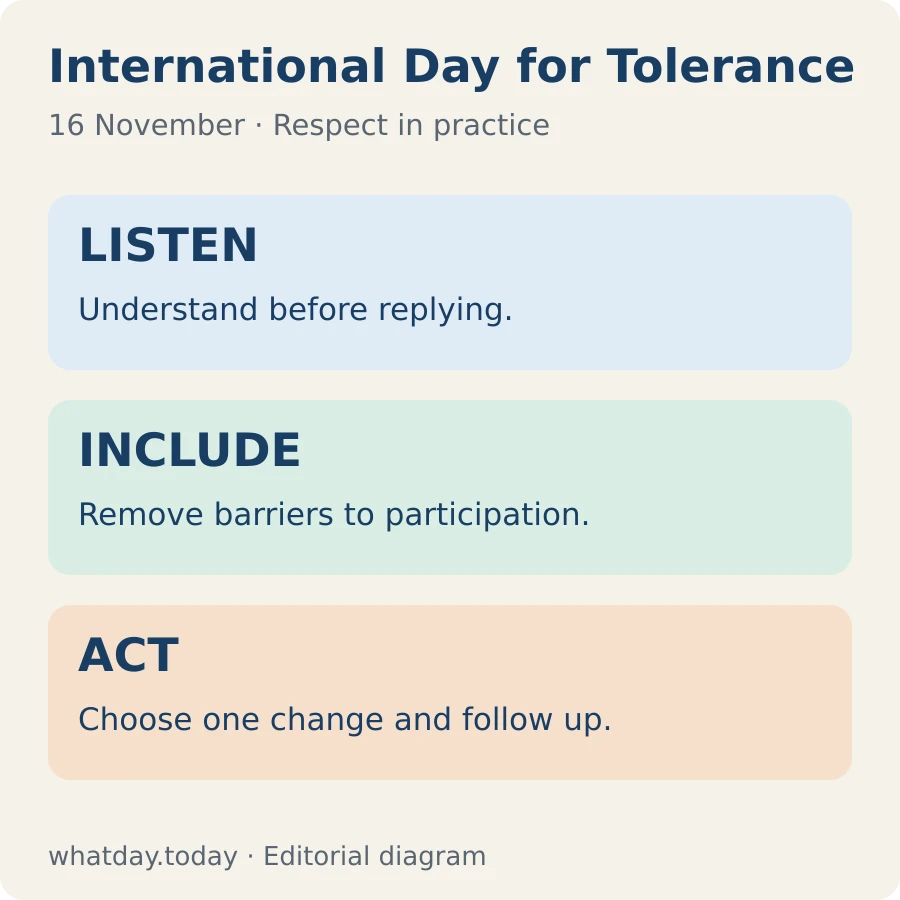
Give pairs an ordinary choice, such as how to spend a free afternoon. One person explains a preference; the other summarises it before responding. Switch roles, then ask: did the summary capture the reason, or only the conclusion? The goal is accurate listening rather than agreement.
Redesign an invitation
Give each group this fictional notice: “Club meeting upstairs on Friday. Bring supplies.” Ask what a new member needs to know. What time? Is there a cost? Is there another way to access the room? How can someone ask a question?
Students rewrite the notice and explain whom each added detail helps. This makes inclusion visible through decisions about access, language and information rather than through a decorative slogan.
Disagreement or exclusion?
Use the two club scenarios above. Ask learners to identify the disputed idea, the people affected and a fair next step. Then change one detail: what if the film cannot be accessed by a member with a disability? Discuss how that changes the question the group must answer.
Turning discussion into a practical change
End with one small commitment: clearer joining instructions, correct pronunciation of members’ names or an alternative way to contribute. Agree when to review it. The follow-up shows whether the exercise changed anything beyond the meeting.
Participants should be able to pass or respond in writing. Nobody should have to represent an entire community or disclose a personal experience to make the lesson work. If a real concern arises, use the school’s appropriate process rather than investigating it in front of the class.
See November 16 for the wider calendar, or explore World Children’s Day for related questions about rights and participation.
Sources
Check the original sources for local arrangements and current guidance. External sources open in a new tab.
Plan around this date
See the day’s calendar · Browse this month · International Day for Tolerance countdown
More to explore

New Year’s Day Beyond Midnight
New Year’s Day is January 1, but celebrations extend beyond the countdown. Selected Spanish, Scottish and Japanese customs carry the occasion from evening gatherings to sunrise and the first days of the year.
Mexico Revolution Day 2026: November 16 Holiday and November 20 Anniversary
Mexico Revolution Day’s 2026 rest day is November 16; the anniversary is November 20. Compare the dates and plan around local opening schedules.

Diwali 2026
When is Diwali in 2026? Check the November 8 date, understand Deepavali and local holiday differences, and learn how to join a celebration respectfully.
Image descriptions and credits are provided in the articles. AI illustrations are labelled.